
Uncovering and interpreting fees in your retirement accounts can be puzzling, even for the most financially savvy. In fact, many people are unaware of the fees they pay.
The FINRA Investor Education Foundation’s National Financial Capability Study (NFCS) Investor Survey found that lack of awareness about fees is a blind spot when it comes to people getting their finances in order. Over 21% of respondents did not think they paid any kind of fee for investing, and 17% said they did not know how much they pay. Among mutual fund owners, nearly 38% believed they did not pay any mutual fund fees or expenses.
Of course, fees are part of any retirement plan. Companies need to generate some money so their business can function. However, not all companies charge the same fees, and they can vary widely.
Paying excess fees can have a huge impact on your savings and future financial security, and may prevent you from creating the complete picture of retirement that you envision.
Types of costs
According to FINRA, costs generally fall into three categories:
1. Transaction costs: Costs associated with buying and selling securities. You’re charged when you make a transaction, which include:
- Commissions, which compensate an investment professional for buying and selling stocks and other securities.
- Markups or spreads, when you are sold securities that the firm has in its inventory.
- Sales loads charged when you purchase or sell mutual funds.
- Surrender charges when you make an early withdrawal from an annuity.
2. Advisory or client fees are charged for advice or portfolio management. They vary depending on the type of service provided.
These fees may also be charged based on the size of your portfolio, referred to as an assets-under-management or asset-based fee. They are generally assessed regardless of whether you buy or sell securities in the portfolio, and whether your account gains or loses money.
3. Ongoing expenses: These are costs you incur regularly, such as annual operating expenses, fees associated with operating and administrating your 401(k) account, and other miscellaneous fees.
Mutual funds and exchange-traded funds have annual operating expenses to cover the professional management and marketing of the funds. And they may charge different amounts to different share classes. Investors can use FINRA’s Fund Analyzer to compare the cost of owning different funds.
Common fees
Fees can be charged by the insurance or mutual fund company, financial advisor, broker, or brokerage. Here are some examples:
- Mortality and Expense (M&E) fee associated with insurance-based products to cover the issuer’s risk of providing death benefits and their administrative costs.
- Operating or administrative expenses.
- Compensation or commissions to brokers/dealers for selling their funds.
- Commissions paid to the financial advisor from the financial or insurance products you buy through them. This may be on top of their hourly, flat, quarterly, or annual fee, which can vary greatly.
- Charges for the company’s cost in managing the fund.
- Surrender charges paid for closing an account before a holding period (surrender period) has elapsed.
According to 403bwise.org, on an average annual basis, variable annuities charge 3%, mutual funds charge 1.74%, and no-load index funds charge 0.07%.
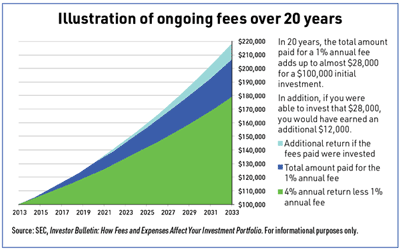
Those fees may seem small, but over time they can really take a big bite out of your savings potential. For example, the Securities and Exchange Commission (SEC) illustrates how much ongoing fees in your investment portfolio can affect your return (see chart) with just a 1% ongoing fee on a $100,000 investment portfolio that grows 4% annually over 20 years. As the investment portfolio grows over time, so does the total amount of fees you pay. Because of those costs, you have a smaller amount invested that is earning a return.
Does zero commissions mean zero costs?
The quick answer is no. Some brokerage firms offer free trades or “zero-commission trading.” Think of it like a doorbuster sale—free trading is a way to attract customers, but free trading does not mean free investing.
FINRA points out that those brokerage firms offering free trading often make money in other ways, such as through interest income from margin loans, robo-advisory service fees, commissions on options or other types of securities, and other charges.
Puzzle it out
So what can you do as an investor to help fill in your retirement picture?
- Ask questions and shop around. For example, you wouldn’t buy a car without knowing what it’s going to cost. Before you sign for a car, you receive itemized costs for special features, floor mats, sales tax, registration, etc. So when you walk away with your new vehicle, you know—to the penny—how much you paid and for what. Treat how you choose retirement accounts the same way and make sure you understand all the costs involved, including costs to purchase, maintain, and sell investments with the companies you research.
- When working with a financial planner or other investment professional, don’t be shy about asking how they are paid. Commission? Assets under management?
Fitting it all together
According to the T. Rowe Price Retirement Savings and Spending Study (2023), respondents with a formal financial plan were 62.5% more confident about their financial outlook.
As a Wisconsin public school employee, you have access to Member Benefits’ financial advisors. If you want help on how to assess fees or review prospectuses, or if you want to evaluate your retirement goals, check out our financial consultation options.
Member Benefits also offers a range of complimentary and in-depth, fee-based services to help you align your portfolio with your financial goals, evaluate if you’re on track to retire, or determine if your current financial position is going to support your desired lifestyle in retirement.
Don’t be puzzled by investment costs. Let us help you complete your retirement vision so you can meet your future financial goals.