
10 ways to build your wealth
No matter what your age, saving enough money to meet your needs and wants is probably up there on your list of priorities. For most of us, it will pose a challenge at some point in our life—or maybe many times. And during a challenging time such as we are facing now, it can cause a great deal of anxiety.
However, some of the basic steps you can take to help build your personal wealth are the same now as they have ever been. Yes, everyone’s situation is different. But following these tips by doing as many as you can—to the best of your ability, based on your situation—may just improve your savings account over time.
1. Save enough
According to the Social Security Administration, a 65-year-old can expect to live another 19 to 21.5 years on average. Further, one-third of 65-year-olds will hit age 90, and 1 in 7 will live beyond age 95. Depending on when you retire, you could be looking at 30+ years in retirement.
Even though your expenses during retirement average 70% of your working years, because of early retirements and active lifestyles, our expenses may be greater than 85% in the early years.
And don’t forget about the impact of inflation. A million dollars after 10 years of 3% inflation is worth about $737,000, before figuring taxes.
For health costs, Medicare doesn’t cover everything. Things like prescription drugs, custodial care, and long-term care are not covered. Consider long-term care insurance and a supplemental insurance plan to cover what Medicare doesn’t. Remember, the longer you live, the more likely you will need long-term care. The Genworth 2019 Cost of Care Survey found that the median monthly cost for a home health aide in Wisconsin is $4,767. A semi-private room in a nursing home facility is $8,273. Plan ahead for possible costly health care expenses.
2. The earlier you save, the better
The earlier you start, the more you can benefit from compound earnings. Compounding is when earnings on your investments are reinvested in your account. The reinvested earnings may also have earnings, and then those earnings are reinvested, and so on. This means that contributing a small amount now could benefit you more in the long run than any larger amount you contribute later on. Even modest monthly contributions have been shown to grow exponentially.
— Kyle Steenport, teacher, Stanley-Boyd Area Schools
You may have heard the phrase, “Pay yourself first.” It can be a powerful savings strategy. It means you pay into your own savings and investments before anything else. Setting up automatic contributions into your retirement account using payroll deduction or electronic funds transfer can make it easier to do.
Kyle Steenport is in his early 20s and just started his first year of teaching at Stanley-Boyd Area Schools. He follows the pay yourself first mentality. “I think it’s important to be saving for my future at a young age. I think a lot of people coming out of college are just so excited to finally have a salary and make money that they forget the importance of saving. All of my family members who are older have been saying for years how imperative it is to start saving up as soon as possible. To me, that means utilizing the benefits you are given through your job.”
Nick German agrees. Nick has spent 18 years in the Appleton Area School District. He teaches high school, coaches middle school, and runs engineering and robotics camps for elementary kids in the summer. “Start saving early and live within your means. My wife and I are both fortunate to be educators. We’re also fortunate to come from modest backgrounds, so we’ve continued to live a simple life as our income has increased over the years. This allowed us to devote an aggressive percentage of our income to our retirement for the first half of our careers.”
Take a look at our infographic to see what happens when you start saving early for retirement. You might be surprised.
3. Don’t spend more than you earn
It’s important to be aware of the money you have coming in versus what’s going out. Spending more than you earn on a consistent basis can build debt quickly! Being in debt has a BIG impact on financial wellness by affecting your credit score, making it harder to get a loan, etc.
Once you’ve assessed your debt, devise a plan to pay off the highest interest debt first. If you need some help, contact one of our financial advisors. We’ll help you come up with a plan to get you back on track. And use our online debt calculators.
The best way to avoid debt is to be proactive about managing your money, which brings us to the next tip…
4. Make a budget
Not only does it help ensure you’ll have money for the things you need and that are important to you, but having a spending plan can also help keep you out of debt (or work your way out of it). And following a budget can make it less likely you’ll spend money you don’t have.
On the more positive side, a budget also helps maximize your savings and investments, allowing you to make sure your hard-earned money is being used to its best purpose. You’ll be better prepared in case of an emergency such as a job loss, major health crisis, or extensive home repair. And it gives you some room to splurge. That may sound counterintuitive, but having a budget can “give you permission” to buy those fancy shoes or purchase those drive-in concert tickets by tracking your expenses and building in an amount you choose for the fun spending.
Another way a budget can help you is to make it easier to clarify your short- and long-term savings goals. Long-term financial goals are often too easy to put off for later. For example, depending on your age, saving for retirement may seem a long way off. However, a budget can help you discover a way to fit it in, even if it’s just a small amount at first.
Here are a few examples of goals you may want to achieve:
- Short-term (0-5 years): Emergency fund, vacations, start a family.
- Intermediate term (5-10 years): New car, new home/condo, college fund.
- Long-term (10 years or more): Retirement savings (IRA, 403(b), etc.).
There’s a need for all three types of saving in your financial wellness plan. Starting earlier than later gives you a huge advantage by utilizing the power of compound earnings (see tip #2).
A budget can also be a helpful tool to use if you have a partner. Kyle, who was recently married, adds, “Another thing I’ve found to be important for my wife and me is our ability to budget and to communicate about money. This saves so many headaches and allows us to be on the same page. Once a month, we review our budget and see how we did. Then we adjust it accordingly. This small step allows us the chance to understand where our money is going and puts it on paper.”
Consider setting up a budget if you don’t have one. You can download a myriad of budgeting apps, set up a simple Excel sheet, or use our interactive budget form.
5. Keep credit card debt to a minimum
Credit card loans crossed the $1 trillion mark last year, reaching $1.08 trillion in the third quarter of 2019 (debt.org). Before credit cards, people knew easily whether or not they were living within their means. But the average credit card debt for Americans reached $6,194 in 2019, and balances increased 3% compared to the year before. Also of note, generations X, Y, and Z tend to carry more debt, including credit card debt, than older generations (Experian). Those who don’t pay attention and overuse their credit cards may not realize they’re overspending until they’re weighed down with debt.
Paying off outstanding bills has many benefits—it improves your credit score, reduces stress, and increases your financial security. Focus on paying off credit cards and other high interest debt.
Use our credit card pay-off calculator to see what it will take to pay off your balance. Visit our financial calculators page for this and many other helpful financial calculators.
6. Don’t chase the market
Especially during times of uncertainty like we’re in now, people tend to make investment choices based on emotion rather than careful consideration of their long-term plan. Selling stocks or cashing out your retirement savings when things look shaky, then buying again when the outlook seems brighter, is a common mistake. Trying to time the market almost never pays off because no one really knows what will happen next. Moving out of your investments into cash or very conservative investments means you may lose any opportunity to recover your losses when the stock market rebounds. One of the best things you can do right now for your retirement is to stay the course for the long term.
7. Create an emergency fund
Plan for unexpected expenses—there will always be surprise financial situations that pop up in daily life. Start with a goal of saving at least three months worth of expenses in your emergency fund—six months is even better if you can do it.
Consider setting up a recurring transaction to place money in your emergency fund each month. If you need to, take it slow and just save $20 per paycheck, increasing as you are able.
Do you already have a well-established emergency fund and it’s calling your name? Every time you consider spending money from your emergency fund, ask yourself these three questions:
- Is it unexpected?
- Is it necessary (a need vs. a want)?
- Is it urgent?
Use your answers to guide your decision to make it less tempting to dip into the fund.
8. Understand and take advantage of your workplace benefits
Understand and take advantage of your benefits including flex spending accounts, health savings accounts, life insurance, disability insurance, WRS, matching contributions to your retirement savings plan, etc. Visit your district office if you’re unclear about the benefits available to you.
9. Have adequate insurance coverage
Stuff happens. Insurance is key to your financial well-being and is an important part of your financial plan. Protect yourself appropriately with auto insurance, renters/home/condo insurance, umbrella insurance, and more.
However, while nearly everyone thinks they are adequately insured, few actually are. If you’re like most people who treat insurance like a commodity (i.e., based solely on price), you risk leaving yourself and your family exposed to financial loss or purchasing coverages you don’t need.
Member Benefits can take a look at your insurance needs and your existing coverage. If you’re well protected, we’ll tell you! If not, we’ll recommend changes and coach you to become a better insurance consumer. Call 1-800-279-4030 for a free consultation.
10. Pay attention to fees
Fees are everywhere—bank fees, credit card fees, loan fees, and retirement account fees. Fees matter. Keep an eye on how much you’re paying in fees because they can take a bite out of your bottom line.
— Nick German, teacher, Appleton Area School District
Remember, Member Benefits is here to help you with financial information and guidance, whether it’s an online resource, an individual consultation, or an in-depth financial plan. “I can’t say enough about Member Benefits’ efforts to help us understand our retirement investments,” adds Nick. “This year we met with Mark Resch (a Member Benefits Consultant) for a short individual consultation. He helped us realize we were on track for a comfortable retirement and that we could afford a larger home that better fits our growing family.
“We appreciate the time and expertise Member Benefits provides our family as we make long-term financial decisions.”
Member Benefit Consultants can provide assistance with your retirement savings accounts but do not offer investment advice. Registered Representatives of and securities offered through WEA Investment Services, Inc., member FINRA. All financial advisory services are offered through WEA Financial Advisors, Inc., an SEC registered investment advisor.
Coffee or Savings
Take a look and see what saving $20 per month could do for your savings goals with our infographic demonstrating the power of compound interest!
If you would like to download a PDF of the infographic, click on the image.
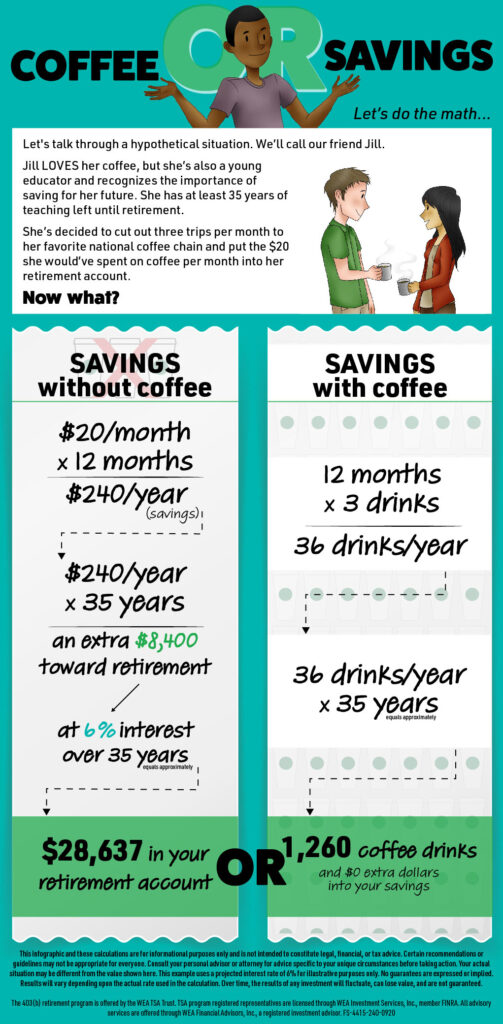
This infographic and these calculations are for informational purposes only and is not intended to constitute legal, financial, or tax advice. Certain recommendations or guidelines may not be appropriate for everyone. Consult your personal advisor or attorney for advice specific to your unique circumstances before taking action. Your actual situation may be different from the value shown here. This example uses a projected interest rate of 6% for illustrative purposes only. No guarantees are expressed or implied. Results will vary depending upon the actual rate used in the calculation. Over time, the results of any investment will fluctuate, can lose value, and are not guaranteed.
The 403(b) retirement program is offered by the WEA TSA Trust. Retirement and Investment program registered representatives offer securities through WEA Investment Services, Inc., member FINRA. All advisory services are offered through WEA Financial Advisors, Inc., a registered investment advisor.
Tips for paying for health care in retirement
Before you start, keep this in mind: Figuring out when you can retire isn’t predominantly driven by your savings; rather, it’s driven by your expenses. Determining the income you need each year to support your lifestyle is important, as well as estimating your future health care costs and insurance options.
Fortunately, you have several options to choose from based on your individual situation.
Employer-sponsored health insurance for retirees
Your school district may offer the option to continue your health insurance coverage as you enter retirement. If so, be clear on what is actually offered and their approach on covering premiums for spouses/partners/dependents. Rising costs are leading many employers to change the retiree benefits they offer, so approach with some caution and be sure you have enough flexibility to go with the changes.
Health savings account (HSA)
An HSA is a tax-advantaged account to help people save for medical expenses that high-deductible health plans don’t cover. Your district may offer this in lieu of employer-sponsored insurance after retirement.
COBRA coverage
COBRA typically extends your current employer-sponsored plan for up to 18 months after you retire. It can be quite expensive. You may be able to use funds from an HSA to pay for premiums.
Affordable Care Act
This public market place for insurance varies in cost by age, state, insurer, plan level, and year. Depending on your income, you may qualify for subsidies.
Private insurance
This is often significantly more expensive than the public exchange, but it may be preferable if you have the resources or specific medical needs. Be careful not to miss the open enrollment period.
Spousal health plan
If your spouse is still working, they may be able to enroll you in their plan, which can be the easiest and most cost effective option. Be sure to talk together about the timing of your retirement and the possibility of other options to bridge the gap.
Work part-time
Some retirees choose to work part-time for the insurance, which can still give you flexibility and plenty of time off depending on the job.
In general, plan for escalating costs over time. Health care costs are anticipated to rise by an average of 5.5% per year over the next decade (CMS). Invest in healthy habits to help you enjoy life and make living more affordable.
Consider whether early retirement is worth cutting back on enjoyable lifestyle expenses in order to pay for health care costs—there is no wrong answer, but it’s important to understand the costs and benefits.
Smart spending
Expecting a tax refund from Uncle Sam this year? According to the IRS, the average 2019 tax refund for those who received one was $2,833—a significant chunk of change.
If you do receive a refund this year, consider using it to improve your financial situation. Here are six great suggestions.
1. Pay off debt
Credit-card loans crossed the $1 trillion mark this year, reaching $1.08 trillion in the third quarter of 2019 (debt.org). Paying off outstanding bills has many benefits—it improves your credit score, reduces stress, and increases your financial security. Focus on paying off credit cards and other high interest debt.
Use our credit card pay-off calculator to see what it will take to pay off your balance. Visit our financial calculators page for this and many other helpful financial calculators.
2. Add to your retirement savings
Add to your current retirement savings plan or open an IRA. You may make contributions before tax (Traditional), after tax (Roth), or some combination of the two up to the IRA limit.
Unsure of which one to choose? Use our IRA comparison tool to determine what may be right for you.
3. Buy more coverage
Umbrella insurance, which provides liability coverage above the limits in your auto and home insurance policies, is often overlooked as an important part of your financial security. You can purchase $1 million or more of additional liability coverage very economically.
Long-term care insurance also helps protect your assets and may be worth a look. It has been called “the greatest uninsured financial risk today.” This is because the majority of costs for extended care services needed during recuperation from strokes, accidents, and illnesses are not covered by your health insurance or Medicare. The chances of needing long-term care usually increase as you age, but long-term care may be needed at any age.
4. Save, save, save
Start an Edvest or other 529 college savings plan for your kids or grandkids. Build up an emergency fund. Start a money market account with a higher interest rate to save for a vacation, a new car, or home remodel. Whatever your goal, you’ll feel better knowing you have a head start on your savings. Our savings calculator can help you understand what it will take to reach your goal.
5. Share the wealth
Consider giving some or all of your refund to your favorite charity. Often monetary donations to charitable organizations are tax deductible, and you’ll feel good knowing your money will go toward helping others in need. WEA Member Benefits Foundation supports public schools and is one way you can give back.
6. Open a Personal Investment Account
A Member Benefits Personal Investment Account offers a way to invest your money outside of a retirement account. It is an alternative to cash accounts such as savings, checking or certificates of deposit and can be registered in your name or opened jointly with anyone. There may also be tax advantages to these types of investments.
Finally, if you received a sizeable tax refund this year, you may want to consider adjusting your income tax withholding. Doing this will reduce your annual refund, but you will be taking home more money each paycheck instead of letting Uncle Sam hold on to it (interest free).
Freshen up your financial knowledge
Build a budget
A budget sets the groundwork for sprucing up your finances. Think of it as a road map for managing your money or a tool that helps you make smarter decisions as you track your monthly expenses.
Not only does it help ensure you’ll have money for the things you need and that are important to you, but having a spending plan can also help keep you out of debt (or work your way out of it).
In simple terms, a budget compares what’s coming in with what’s going out. And it’s not just for those who need to closely monitor their money—even people with large paychecks and lots of money in the bank can benefit too.
Why have a budget?
- It helps maximize your savings and investments, allowing you to make sure your hard-earned money is being used to its best purpose.
- You’ll be better prepared in case of an emergency such as a job loss, major health crisis, or extensive home repair.
- You can build in a plan to pay off debt.
- It gives you some room to splurge. That may sound counterintuitive, but having a budget can “give you permission” to buy those concert tickets or celebrate at that nice restaurant by tracking your expenses and building in an amount you choose for the fun spending.
- It can help you clarify your short- and long-term savings goals. Long-term financial goals are often too easy to put off for later. For example, depending on your age, saving for retirement may seem a long way off. However, a budget can help you discover a way to fit it in, even if it’s just a small amount at first. Starting earlier than later gives you a huge advantage by utilizing the power of compound earnings (see next page).
- You’ll be less likely to spend money you don’t have. Before credit cards, people knew easily whether or not they were living within their means. But in 2017, the average American had a credit card balance of $6,375, up 3% from the year before (Experian). Those who don’t pay attention and overuse their credit cards may not realize they’re overspending until they’re weighed down with debt.
Budgets are not just about saving and spending. One important aspect of your financial health is protecting yourself from loss with appropriate insurance coverage. We can help you assess what you need.
Budgeting options
You don’t need to be a math whiz to create and maintain a budget. Spreadsheets and online software can take care of the calculations for you. Do a search for software online, create your own spreadsheet, or go old school with a ledger—whatever works for you.
Stick with it
The point of a budget is to give you more financial freedom, not less. If you find yourself having a hard time following a budget, follow these tips:
- Keep your future top of mind and remember how your budget will help you get where you want to be.
- Make it more difficult to impulse buy. Take yourself off of retailer e-mail lists and remove your stored payment information online so you can’t just click to order.
- Find a like-minded friend or online budgeting forum to help keep you accountable.
- Use cash more often—swiping a card is less “real.”
- Reward yourself once in a while with something you enjoy.
- Educate yourself by exploring the financial resources on our website or attending one of our free financial seminars.
Creating a budget is not a “one and done” project. Once you’ve built your budget, review it regularly and make adjustments because life changes…just like the seasons.
Save for your future
Saving for retirement should be at the top of your list of long-term budget goals.
While Wisconsin public school employees are fortunate to have the Wisconsin Retirement System (WRS), WRS is not enough. And don’t count on Social Security to fill in the gap. On average, Social Security payments make up only about 14%–28% of retirement income for those who receive WRS. To build a secure retirement, you need three things: WRS, Social Security, and your personal savings.
Personal savings options
You can save with a 403(b) through your district, and if eligible, you can also open an Individual Retirement Account (IRA). With an IRA, and sometimes with the 403(b), you can choose between a pretax or Roth account (see below).
If your employer (or your spouse’s employer) offers a match in your 403(b) plan, take it. It’s free money. Added bonus: The match effectively increases your income without increasing your tax bill, since you pay no taxes on matching contributions until you withdraw them in retirement.
Most Wisconsin public school employees can expect their retirement income to come from:
-
Wisconsin Retirement System
-
Social Security
-
Personal savings
Start sooner than later
The earlier you start, the more you can benefit from compound earnings. Compounding is when earnings on your investments are reinvested in your account. The reinvested earnings may also have earnings, and then those earnings are reinvested, and so on. This means that contributing a small amount now could benefit you more in the long run than any larger amount you contribute later on. Even modest monthly contributions can grow to several hundred thousand dollars over three or four decades.
Make it automatic
If you have an IRA, making contributions directly from your savings or checking account will make it much easier to save. With Member Benefits, you can set up SmartPlan.
If you haven’t started saving for retirement yet, give us a call. We can help you open an account or simply answer any questions you may have.
Brush up on investing terms
Now that you’ve decided to start saving for retirement, what do you need to know? Here are a few investing terms to familiarize yourself with.
Pretax vs. Roth (after-tax)
Traditional (pretax) accounts allow you to defer the taxes on your contributions and at the same time reduce your taxable income. The earnings grow tax-deferred but both the earnings and initial investment will be taxed when withdrawn.
Roth accounts allow for after-tax contributions. You pay taxes now in exchange for tax-free treatment of earnings on qualified withdrawals.
Diversification
Having a variety of investments in your portfolio helps manage risk. Historically, it also yields higher returns as the positive performance of some investments offset the negative performance of others.
Risk
Before you consider any investment, you need to understand risk and determine your personal risk tolerance. Lower risk investments have averaged modest long-term historical returns. Higher-risk investments, such as large company, small company, and foreign stocks, have averaged higher returns historically, but with more volatility or fluctuation in value. Learn your risk tolerance by using our “What kind of investor are you?” calculator.
Asset allocation
This is how you divide your money among stocks, bonds, and short-term reserves. The aim is to control risk by diversifying your portfolio. Your allocation should be based on your tolerance for risk.
Fees
The impact of fees over time on your IRA or 403(b) account can significantly reduce your nest egg. Pay attention to all of the costs, including plan fees and mutual fund expense ratios. Not all providers or funds charge the same fees. Visit weabenefits.com/fees to learn more.